
The light cruiser Nagara was an Imperial Japanese Navy warship that sank off Ushibuka, in the Amakusa Islands (Kumamoto Prefecture), after being torpedoed by a U.S. submarine during World War II. Of her 583 crew, 348 were killed, and the wreck remains a reminder of the tragedy of war.
Each year on August 7—the day she was sunk—a memorial service is held "to pay tribute to the spirits of the crew, and to convey to as many people as possible the horror of war and the value of peace." In 2025, an additional offshore memorial service was conducted on August 9 to mark 80 years since the end of the war.
It was around that time, while I was being interviewed during our underwater investigation at the Chousei Coal Mine, that a journalist, Mr. Seiichiro Nishinaka, told me, "I am a family member of one of the fallen from Nagara." That was what led me to begin studying this ship in earnest.
Afterward, I began communicating with the Ushibuka Branch of the Amakusa City Social Welfare Council, which organizes the memorial service, and with the bereaved families, and we moved forward toward an underwater investigation.
Nagara's resting place has already been identified, but it lies far beyond the depth range of ordinary recreational diving—in the domain of advanced technical diving.
DIVE Explorers (led by Yoshitaka Isaji) has continued to work on unexplored underwater caves and deep-water environments. We are applying the techniques and experience gained through that exploration and investigation to this project as well, in order to record the present condition of Nagara, and we will report on the progress of the wreck investigation on this page.
Nagara was one of the Nagara-class light cruisers, completed in 1922 (Taisho 11), and she was operated as an active frontline warship during the Pacific War. The class consisted of six ships: Nagara, Isuzu, Natori, Yura, Kinu, and Abukuma. Together with the Kuma-class (the first group) and the Sendai-class (the third group), they are collectively known as Japan's "5,500-ton light cruisers."
Nagara also carried a shipboard shrine: Inaba Shrine of Gifu City, Gifu Prefecture, was enshrined aboard her.
Principal particulars of Nagara
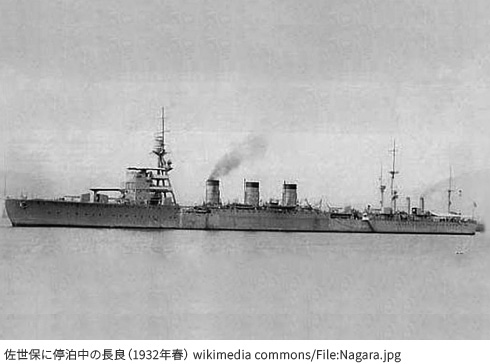
In July 1944, Nagara was engaged in transporting civilian evacuees from Okinawa to Kagoshima. She departed Naha on August 5 and arrived at Kagoshima on August 6.
On August 7, 1944—the day after the evacuees had gone ashore—she was torpedoed by the U.S. submarine USS Croaker.
Nagara sank about 10 km off Ushibuka, Amakusa City. Of her 583 crew, 348 are recorded as killed, and 235 (237 in some records) were rescued and survived. The survivors are said to have been rescued by fishermen of Ushibuka.
At the time, the sinking of Nagara was strictly concealed as military information. During the war, and for some time after it as well, memorial activities were rarely conducted.
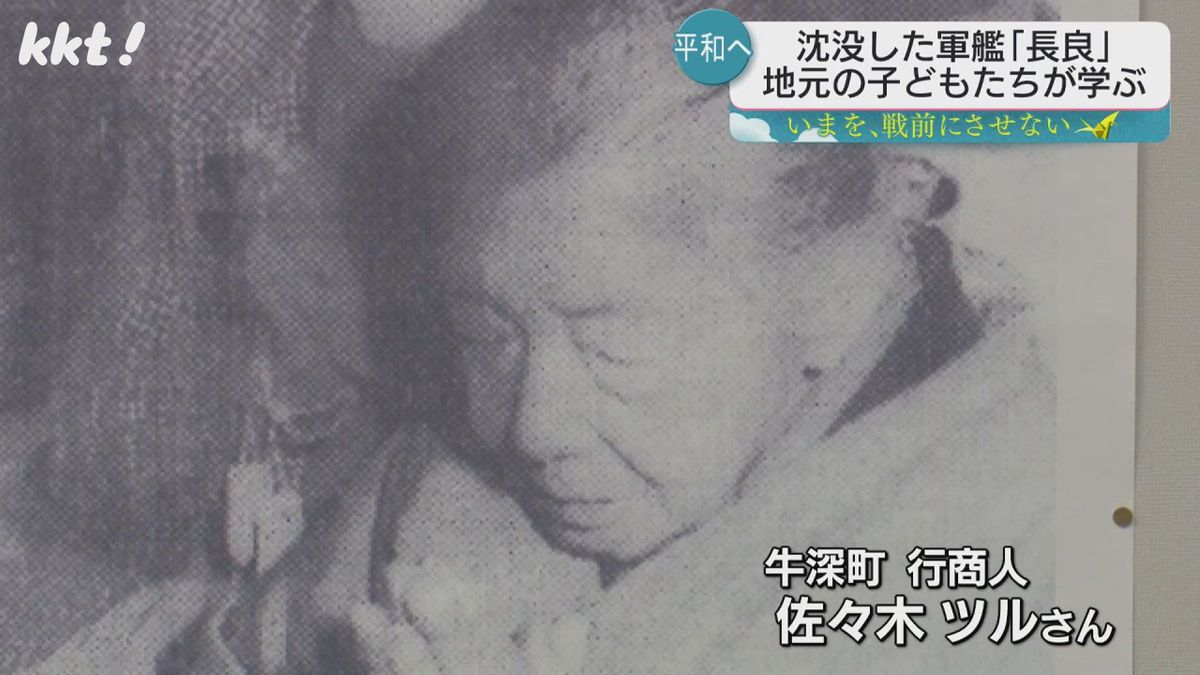
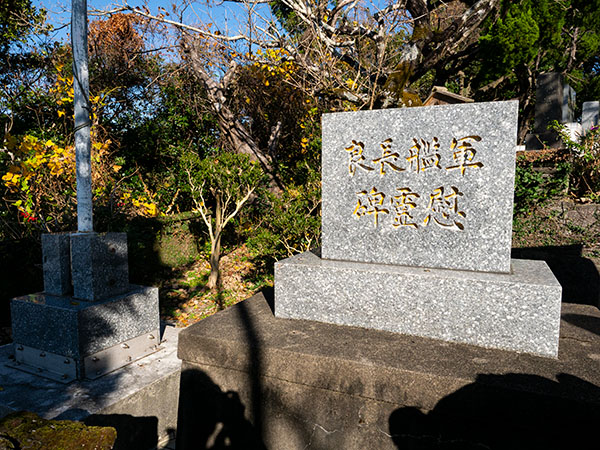
However, Tsuru Sasaki (born 1898; died at 88) continued memorial activities for many years out of personal conviction. In 1970, she used her own funds to build the Nagara Memorial Monument at a veterans' cemetery on a hill overlooking the sinking site, and she is said to have prayed there every morning.
Her commitment was inherited by the Ushibuka Branch of the Amakusa City Social Welfare Council, and the memorial service is now held every year on August 7 as an established annual observance.
In 2025, marking 80 years since the end of the war, an offshore memorial service and ceremony were also held. For the offshore service, bereaved families and others involved boarded the Japan Maritime Self-Defense Force minesweeper Toyoshima, and approximately 150 people attended the ceremony that followed.
While these memorial activities were being carried on, a journalist who had come to cover my underwater investigation—Mr. Seiichiro Nishinaka—told me, "I am a family member of one of the fallen from Nagara." Mr. Nishinaka is a grandson of Nagara's commanding officer, Captain Giichiro Nakahara. That was the beginning of my connection with this ship.
At first, I knew that Nagara and the memorial service existed, but I did not know their present situation in any detail. As I listened further and carried out research and interviews with those involved, I came to feel the commitment of the people working to pass down the story of Nagara. I came to think that if we actually dived and recorded the present condition of Nagara in photographs, and documented any personal effects we might encounter, it could help support that inheritance of history.
I have conducted many wreck investigations, and each time I am reminded that a wreck is a "witness of history." For that reason, I believe that an underwater investigation cannot be treated as mere underwater work: it is essential to engage with the ship's background—its history, and the feelings of the people connected to it.
With that in mind, we contacted the Ushibuka Branch of the Amakusa City Social Welfare Council, who have carried that history forward, and the bereaved families, and arranged to visit Ushibuka in Amakusa City in December 2025.
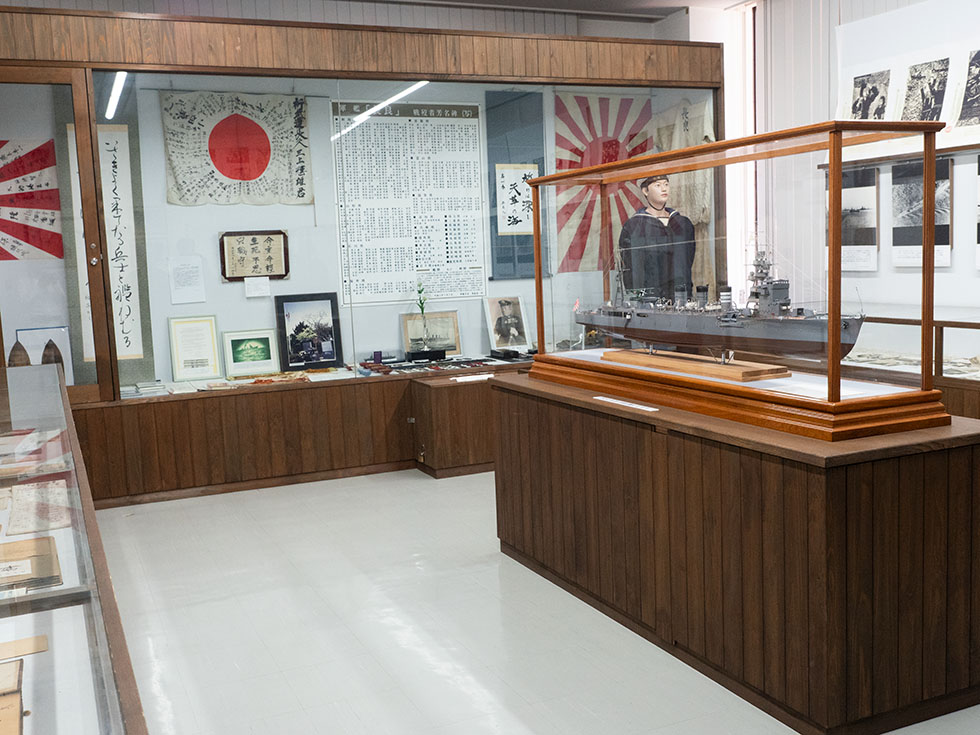
The Social Welfare Council building also houses the Nagara Memorial Museum. We hoped both to understand what this ship means to the people there, and that the photographs we take might help in passing down the story of Nagara.
One member of the Social Welfare Council told us that having more material to pass down is something to be grateful for. In any case, our intention is to undertake something that assists those who have carried this history forward, and we also intend to discuss what we will do—and, equally, what we will not do.
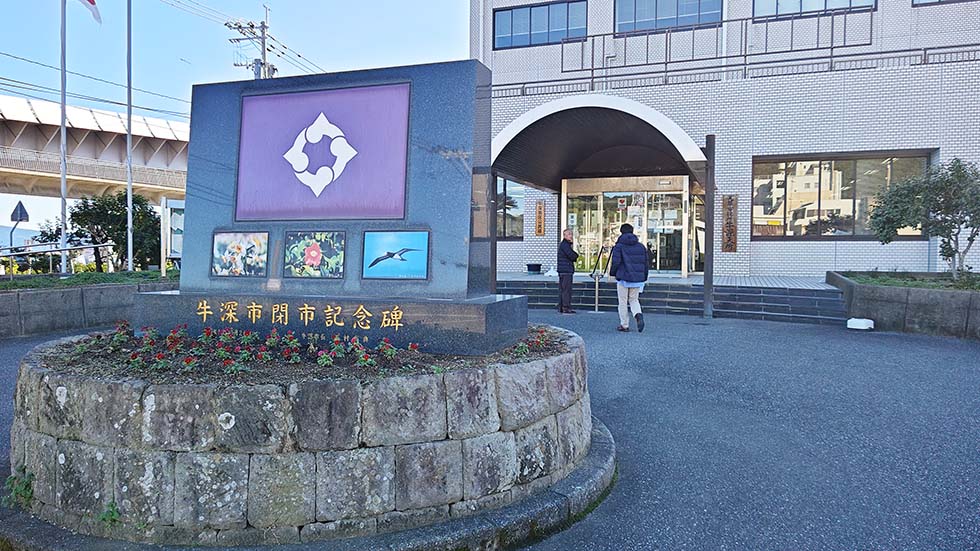
the Ushibuka Branch of the Amakusa City
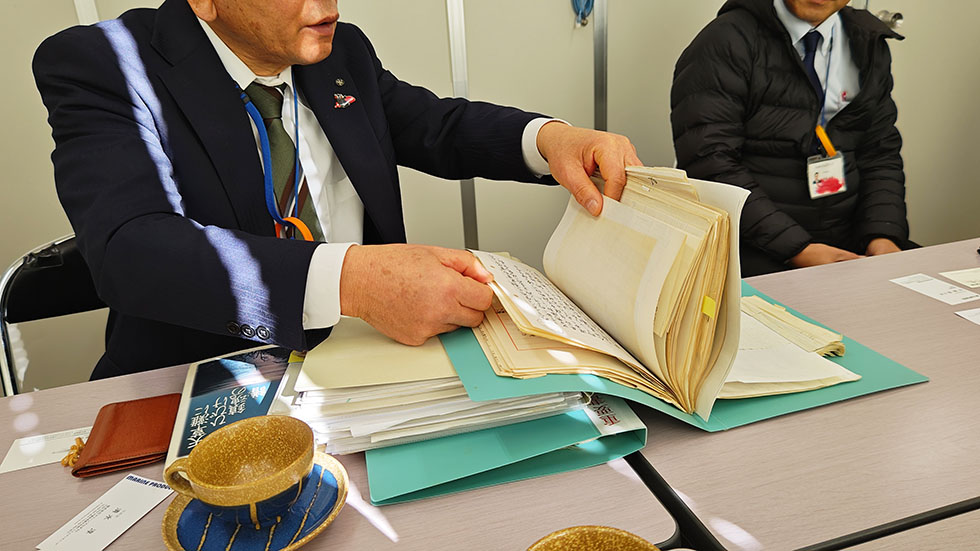
On December 22, 2025, I visited the Ushibuka Branch of the Amakusa City Social Welfare Council together with Mr. Seiichiro Nishinaka, whose account had prompted this project.
During the visit, we heard directly from those who have carried the memorial activities and the work of passing down this history. We were told that documenting and photographing the present underwater condition of the wreck had been a long-held wish. With 80 years since the end of the war now marked, the visit was an occasion to reaffirm the value of leaving records as "material to pass down."
We also heard about what they did not want us to do. We were told that a decision not to recover remains had been reached in the past as the consensus of the bereaved families' association, and that, for personal effects, they would prefer that we limit ourselves to photography for the time being.
Even before the visit, I had felt that a great many people's thoughts are gathered around Nagara. Among them, Mr. Soichi Fukumoto of the Amakusa City Social Welfare Council—who was asked directly by the late Tsuru Sasaki to take over the memorial work—holds feelings for Nagara that struck me as extraordinary, and I renewed my resolve to approach this work with still greater care.
Mr. Fukumoto also showed us a photograph of an echo-sounder image that had captured Nagara, on which was written "depth: approx. 80 meters."
The Social Welfare Council facility also houses the Nagara Memorial Museum, where many records and photographs of Nagara are exhibited. A visitor comment notebook there showed that people come from across Japan—a result, we felt, of the sustained work of passing down the story of Nagara.
Following that, we were introduced to Diving Shop Tomikawa, which has supported the memorial service every year.
The owner, Mr. Tomikawa, runs the shop with his wife, and they provide the boats that the bereaved families board at the memorial service. When we asked for their cooperation in various matters in carrying out our investigation of Nagara, they readily agreed.
Nothing could have been more reassuring than the cooperation of a local diving service that knows these waters.
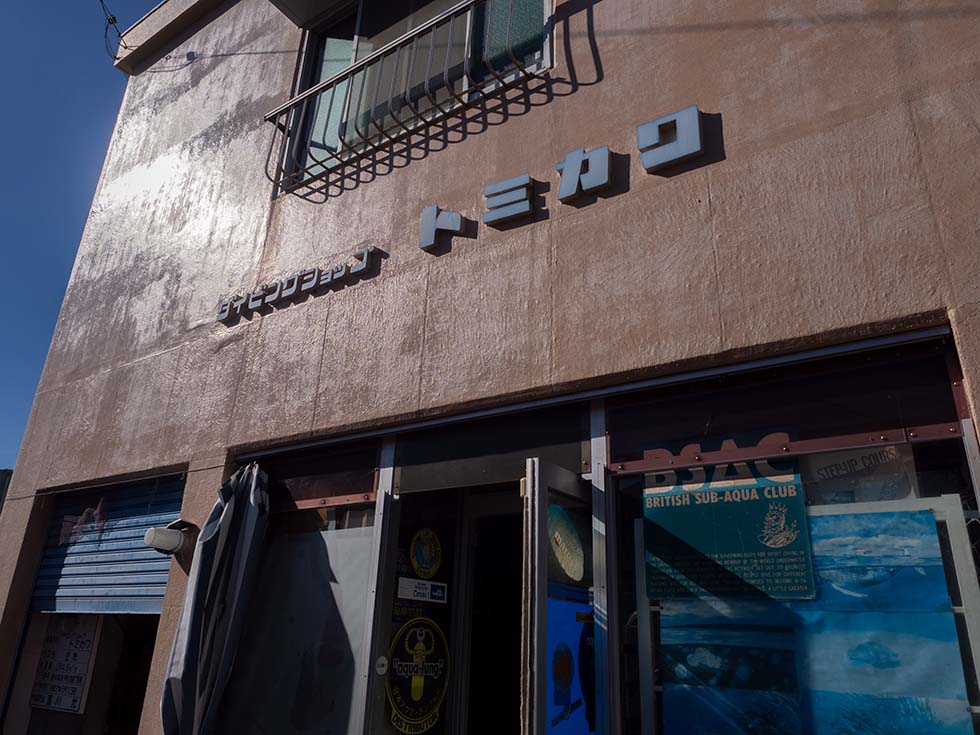
Diving Shop Tomikawa
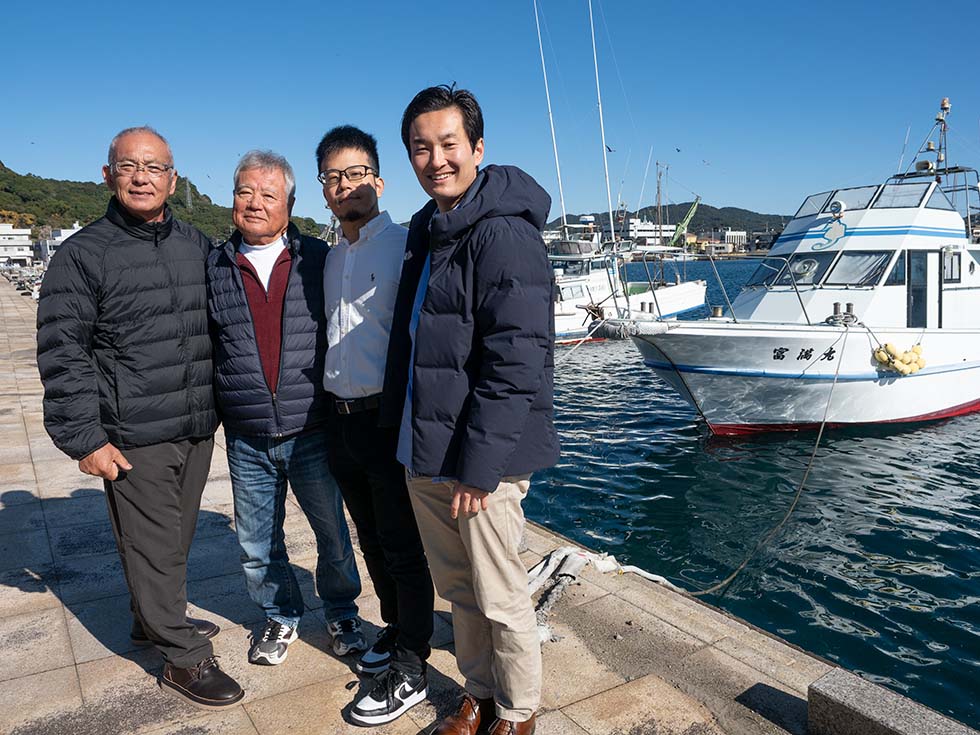
Mr.Tomikawa and Us
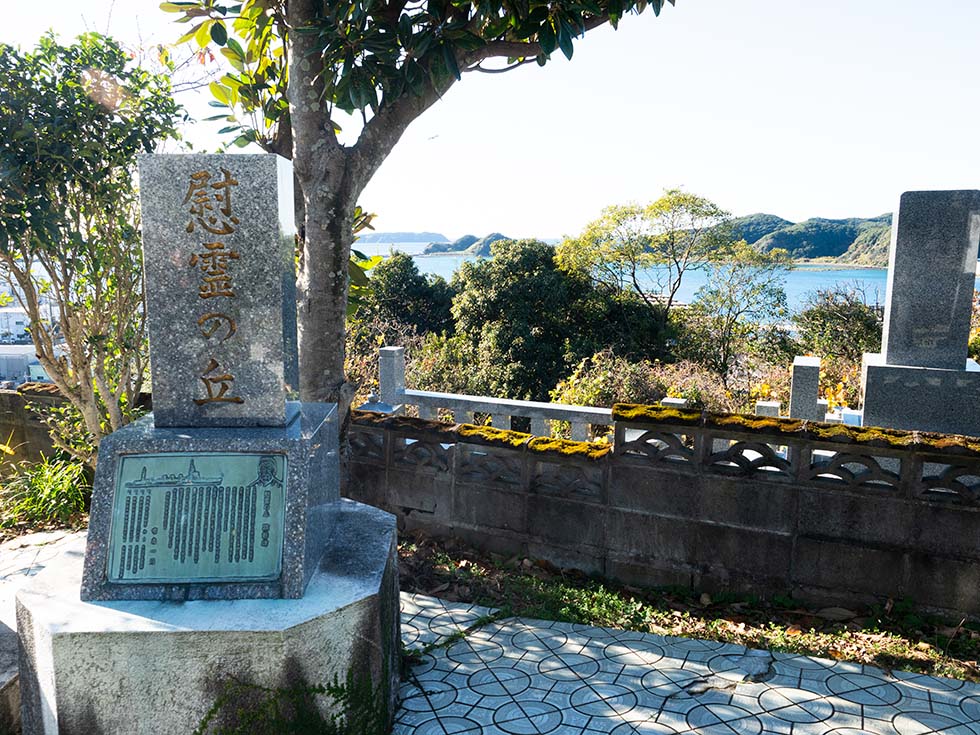
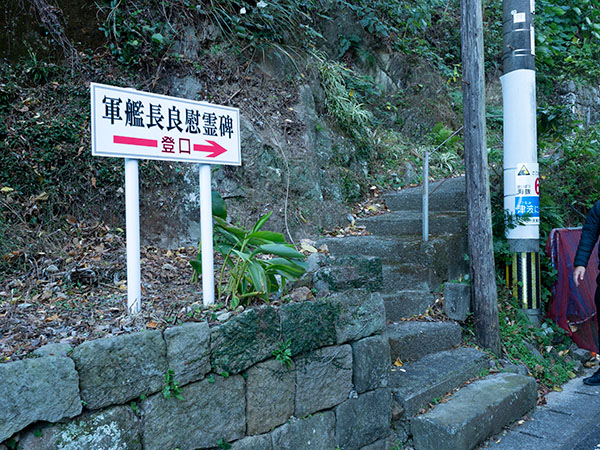
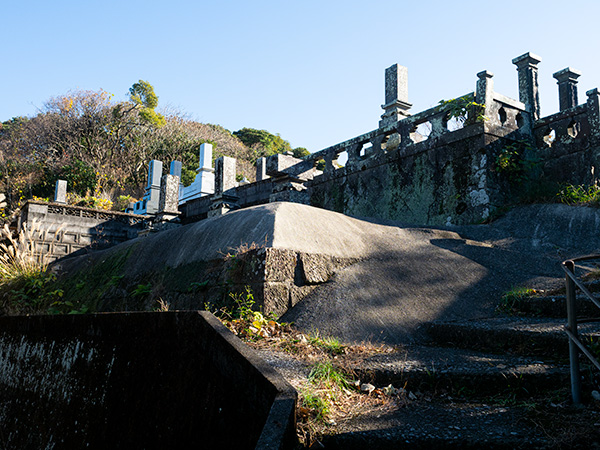
The place where Tsuru Sasaki built the memorial monument is now known as the "Hill of Remembrance." From earlier media coverage we had heard that the monument stands on high ground overlooking the sinking site, and we were guided there as well.
When we asked the Social Welfare Council staff who maintain the monument, we were told that the point directly below it, looking straight down, is exactly where Nagara sank.
From the road to the monument is a climb of more than 120 steps, and we were told that the Social Welfare Council staff also carry out the cleaning there. That this daily care continues made a strong impression: remembrance here is kept not only as an annual "event," but as part of everyday life.
Related media coverage (About Dec 2025 Local Visit)
※ Mr. Kojiro Nakahara, grandson of Captain Giichiro Nakahara of Nagara
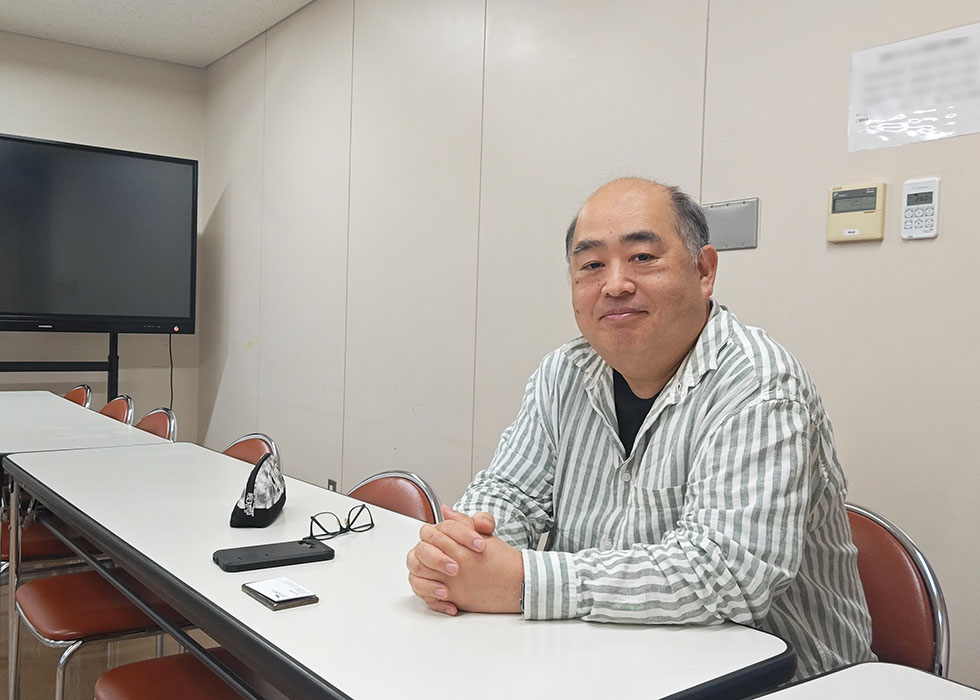
On April 23, 2026, as part of our preparations for the underwater investigation of Nagara, I visited Nara University and met Mr. Kojiro Nakahara, a grandson of Nagara's commanding officer at the time, Captain Giichiro Nakahara.
Mr. Nakahara was the representative of the bereaved families who delivered the address of thanks at the "Nagara Offshore Memorial Service and Ceremony" held at Ushibuka in 2025 to mark 80 years since the end of the war. He spoke of his gratitude that, even 80 years after the sinking, the memorial has continued in Ushibuka, and of the importance of carrying that memory to the next generation.
This visit was not simply an explanation or a report ahead of the investigation.
On the seafloor toward which we are heading there is not only a wreck, but the memory of those who died, the feelings of the bereaved families, and the history of remembrance that the people of Ushibuka have protected for many years. The visit was also a way of reaffirming that.
In my wreck investigations I have said that a wreck is a witness of history. Through this visit, I came to feel the meaning of those words still more strongly. To record a wreck is not merely to confirm the shape of a hull or the circumstances of a sinking. It is also the work of recording what remains on the seafloor now, and reconnecting it with the memories of people on land.
Nagara is recorded as lying at a depth of approximately 80 meters in open ocean, which makes it an extremely demanding target for an underwater investigation. There are many obstacles to clear: technical preparation, safety management, a filming plan, and coordination with the people on site.
Even so, if this investigation can leave the present condition of Nagara in photographs and video, it will not only support the continuation of the memorial, but may also become new material for conveying the memory of the war to generations who do not know Nagara.
After visiting Mr. Nakahara, I recognized again that we must carry out this investigation not as a deep wreck investigation alone, but as an investigation that hands records over to the bereaved families, to the local community, and to future generations.
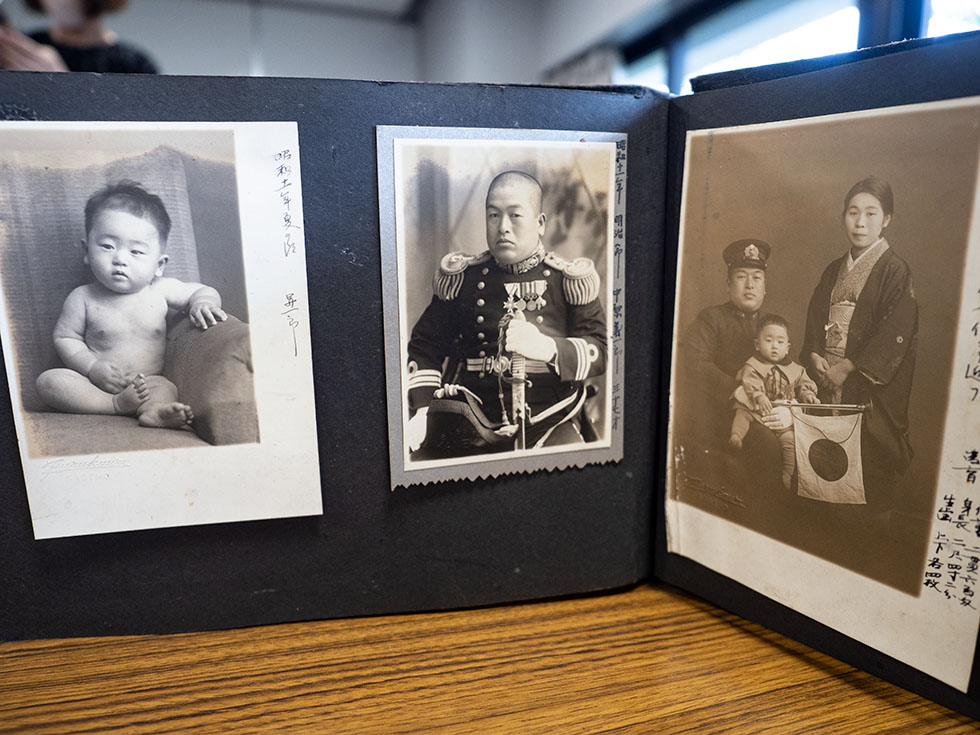
※ A photograph of Captain Giichiro Nakahara, brought to the conference
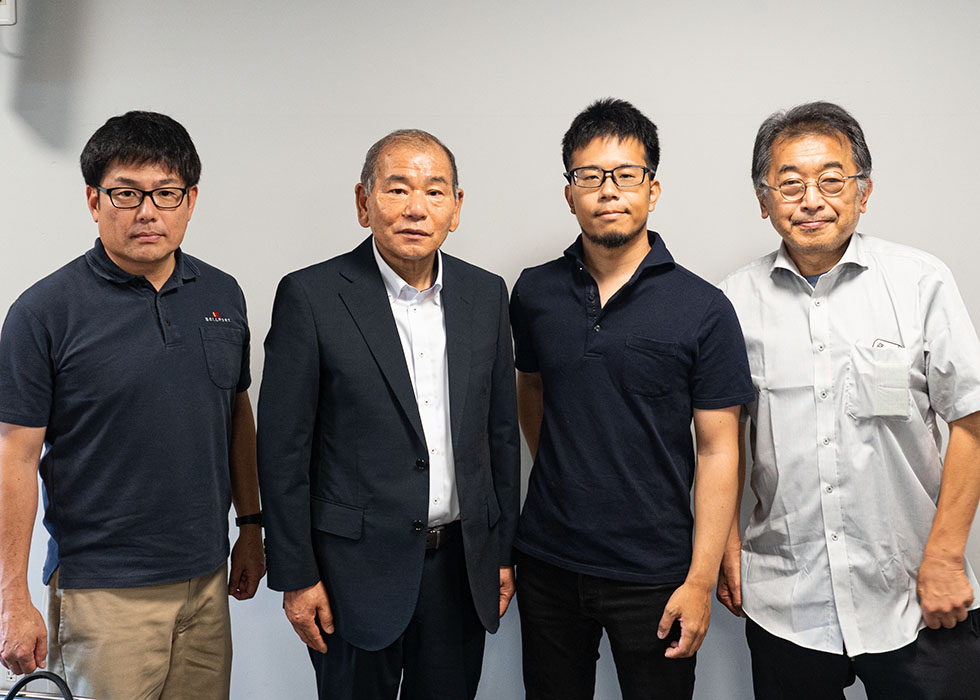
※ With those who joined us at the conference
On July 6, 2026, we held a press conference at "Kokorasu," a multipurpose facility in Amakusa City, Kumamoto Prefecture, to announce the underwater investigation of the light cruiser Nagara. About 30 reporters took part, in person and online.
Joining us at the conference were Mr. Seiichiro Nishinaka, a member of the family of Nagara's commanding officer; Mr. Soichi Fukumoto, former Managing Director of the Amakusa City Social Welfare Council, who has devoted many years to memorial activities; and Mr. Kazumichi Murai of Bellport Uto (Uto City, Kumamoto Prefecture), who would support the investigation with an ROV (remotely operated vehicle).
The bereaved families, those who have worked on the memorial for many years, and the people of the local community—we are very glad, and greatly reassured, to be able to proceed with the support and cooperation of all of them.
The conference was reported by media in Kumamoto, and also in the Hokuriku region, the home region of many of the crew, as well as elsewhere in Japan.
Related media coverage (About the July 6, 2026 Press Conference)
Ahead of the operation itself, on July 14 and 15 we carried out a simulation based on the conditions we expected on site, at Osezaki in Izu, Shizuoka Prefecture, together with Mr. Hirokazu Mori and Mr. Yosuke Ogiwara, who would be diving with us.
Osezaki is also our home ground. Choosing a place we know well allowed us to reduce every load other than the training itself. The local diving services there also understand technical diving very well, which makes it a place we are grateful for.
Near Osezaki there is a gas filling facility of which we are members, where cylinders can be filled with gases that ordinary diving facilities cannot supply, such as trimix and oxygen. In that sense too Osezaki is our home, and this time, after the training, we loaded the cylinders and the diver propulsion vehicles into a vehicle, and Mr. Mori transported them from Shizuoka to Kumamoto.
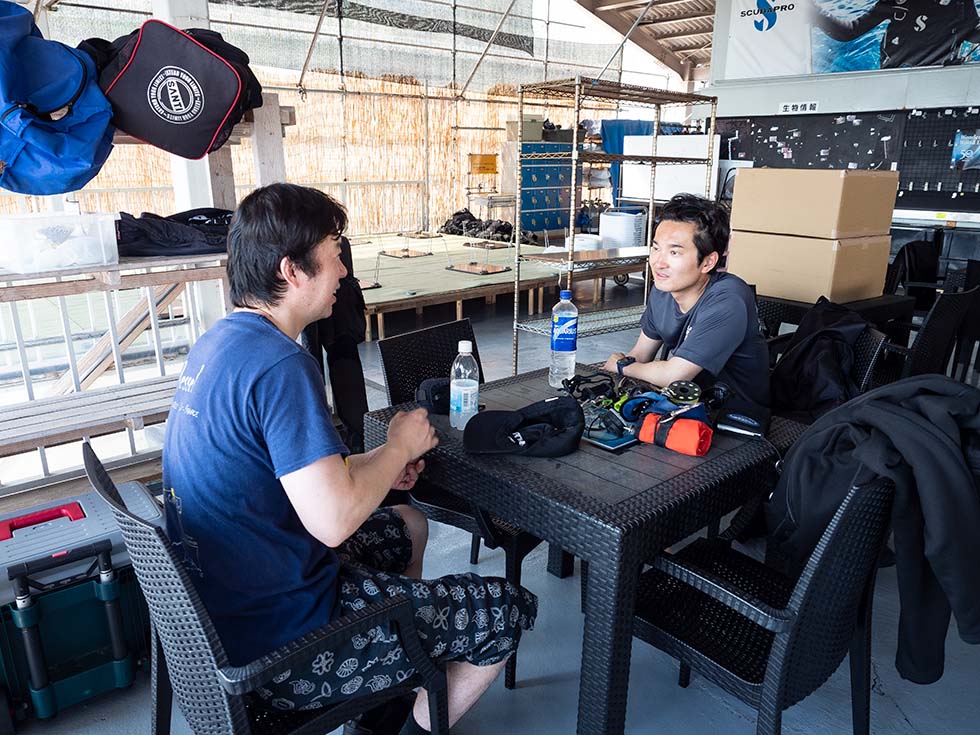
※ Two team members in a pre-dive briefing
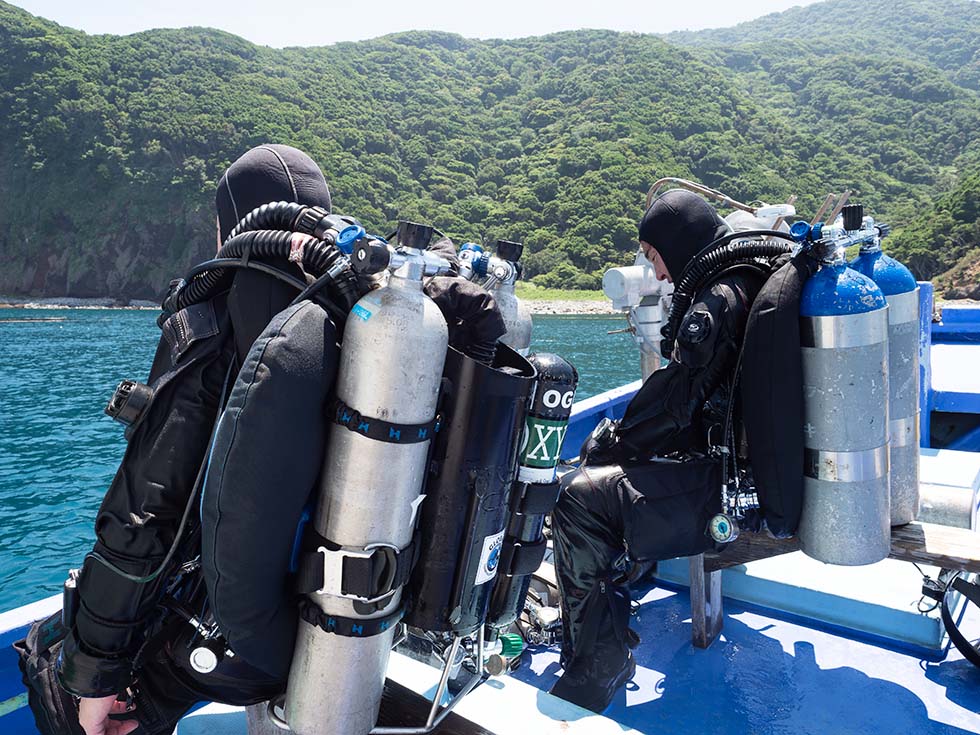
※ Preparing for entry with rebreathers and twin cylinders
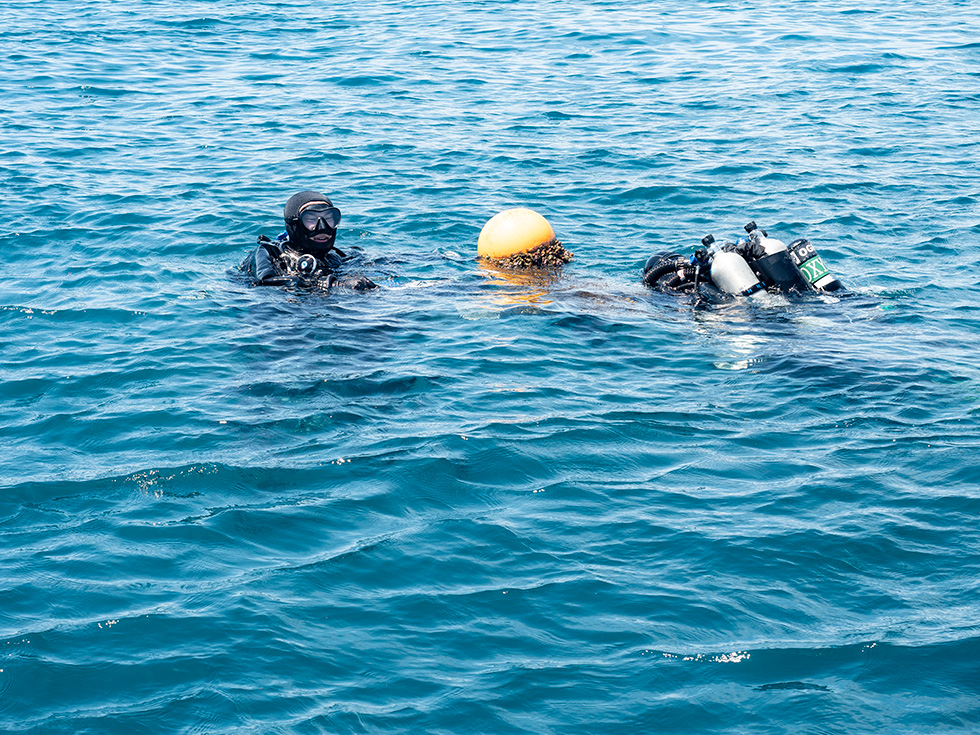
※ Simulation training at Osezaki
What we reproduced was the whole sequence from a boat entry using diver propulsion vehicles through to the exit, and the task of filming.
Entry, exit, and the execution of a task are areas that, in technical diving, tend to be treated lightly even though they are explained. On a site like this one, however, we have to build everything ourselves, starting from the design of how a dive can be made possible at all.
There is a very large difference between diving in an environment where everything has been arranged for technical diving and what a site of exploration demands. I believe that without this simulation we would not even have been able to enter the water on the day.
On the 15th we trained the procedure of setting equipment on an anchored line in advance and donning it in the water. Even this one procedure requires a great deal of consideration: in what order it is done, who places which piece of equipment where, and how long it takes. It is not a procedure taught in a certification course; you only recognize that it needs working out once you have experience in the field.
Furthermore, all of this training was carried out while carrying filming equipment. This too is because we dive in order to carry out the task of filming; simply diving has, in itself, no meaning as exploration.
Exploration is supported by team members who understand the need for training of this kind and who face it earnestly together. I am keenly aware of that.
All members arrived on site on July 19, and over that day and the following day we assembled equipment, confirmed the dive plan and the ERP (Emergency Response Plan), shared them with the boat captains and staff, and loaded the boats.
We also held preparatory meetings with Mr. Kazumichi Murai of Bellport Uto, who would support us and film with an ROV, and with Captain Koki Matsumoto of the Mikimaru, on which their team would be aboard. There we decided that, although we would be aboard the boat of Diving Shop Tomikawa, we would set our cylinders on the line anchored by the Mikimaru and descend along that line.
We prepared two decompression plans. One assumed an average working depth of 80 meters, with a bottom time of 25 or 30 minutes; the other assumed an average of 90 meters, with 20 or 25 minutes. Because the hull has height, the former would reach a maximum of 90 meters and the latter a maximum of 100 meters. We did not decide which would be the primary plan, and left the choice to the conditions on the day.
On that basis, we set in advance a turn-back criterion: if the average working depth was expected to exceed 100 meters, we would not dive.
As for the team, for the first day of diving on July 21, Mr. Mori would take the surface and the shallow depths while Mr. Ogiwara and I went to the hull; on the following day I was to take the surface and the shallow depths.
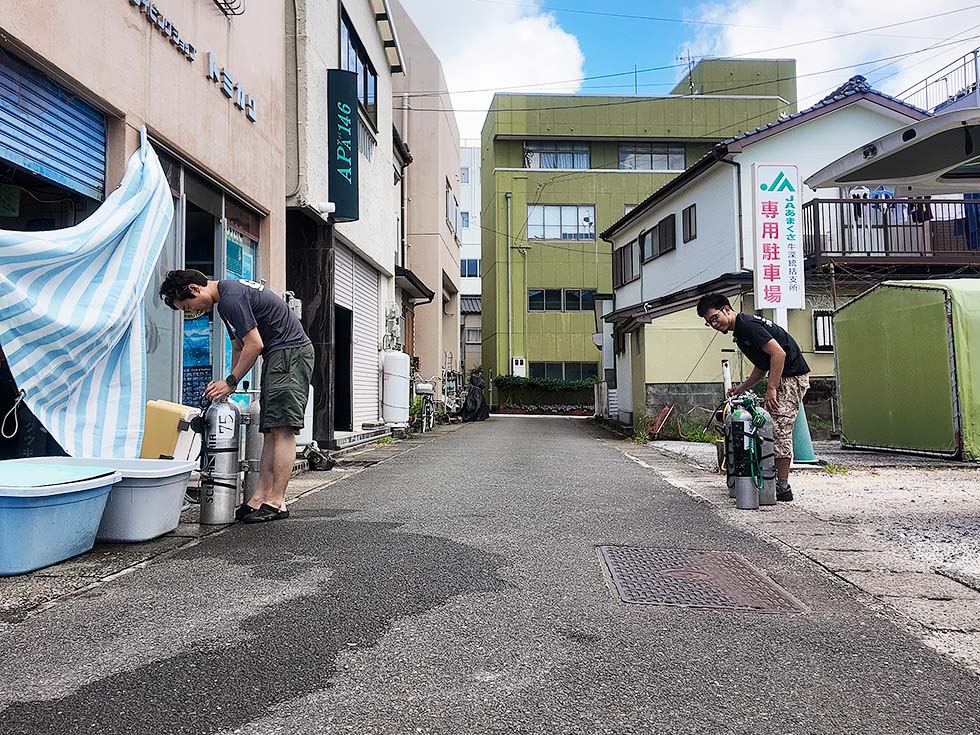
※ Assembling equipment at Diving Shop Tomikawa
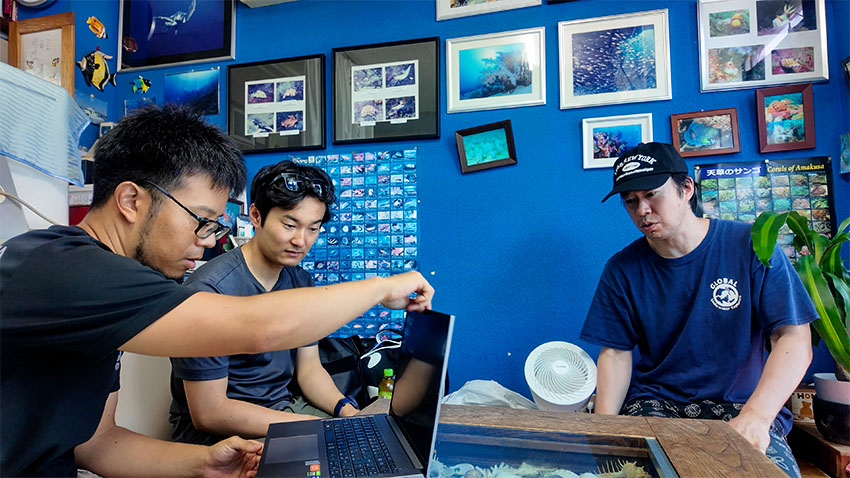
※ Working through the decompression plan, procedures and timetable in detail
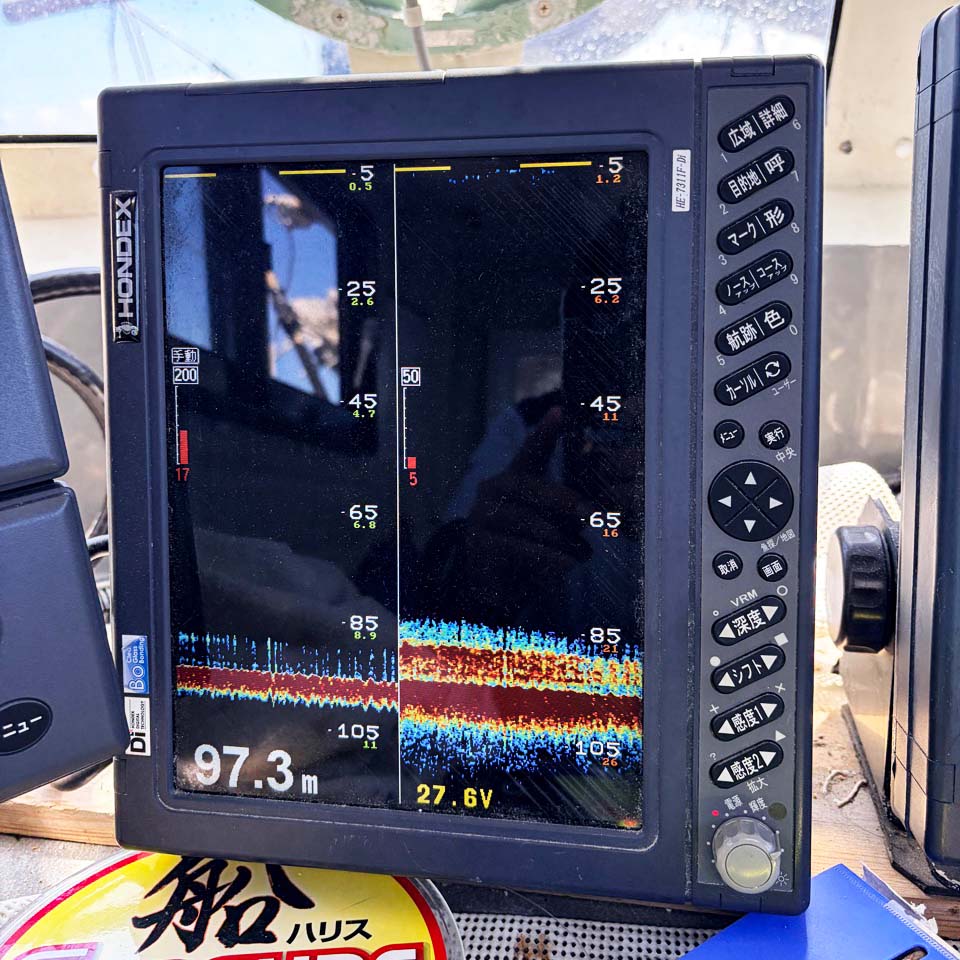
※ The fish finder reading
On July 21, we boarded the boat of Diving Shop Tomikawa and the ROV team boarded the Mikimaru, and we left Ushibuka Port, reaching the site in about 45 minutes. The sea was calmer than one would expect in open ocean, with almost no current and almost no swell. Mr. Soichi Fukumoto, who has been involved in the memorial for many years, said that it was rare for conditions to be this good—as though we were being welcomed for our dive.
On the other hand, the bottom depth we confirmed on the echo sounder was 100 meters. This differed greatly from the depth of 80 meters we had been given in advance, and it put us on edge.
We had, however, anticipated in advance that this could happen, and had prepared a plan for an average working depth of 90 meters (since, if the bottom of the hull is at 100 meters, the deck would be at around 90 meters). There was therefore no great confusion, and we could proceed simply on the judgment: "of the two plans, take the deeper one."
Before entering the water, I confirmed two points again with Mr. Ogiwara. The first was to control the dive so that the average working depth would be 90 meters. The second was what we would do if Nagara was not in sight when we reached the bottom. To be clear, "controlling the average working depth to 90 meters" does not mean limiting the maximum depth to 90 meters.
On this dive, an anchor attached to a line was to be dropped from the boat that marked our starting point. At depths like these, however, an anchor does not drop straight down from where it is released. It is normal for it to be displaced to some degree by the current. In other words, there was every possibility that Nagara would not be in sight when we arrived at the bottom.
We therefore fixed the search procedure as follows: tie a line to the anchored line and begin searching; keep the extent of the search within the planned time, and within the space that a 60-meter spool of line could reach. We also asked the captain which side of the hull the anchor was likely to have been displaced toward.
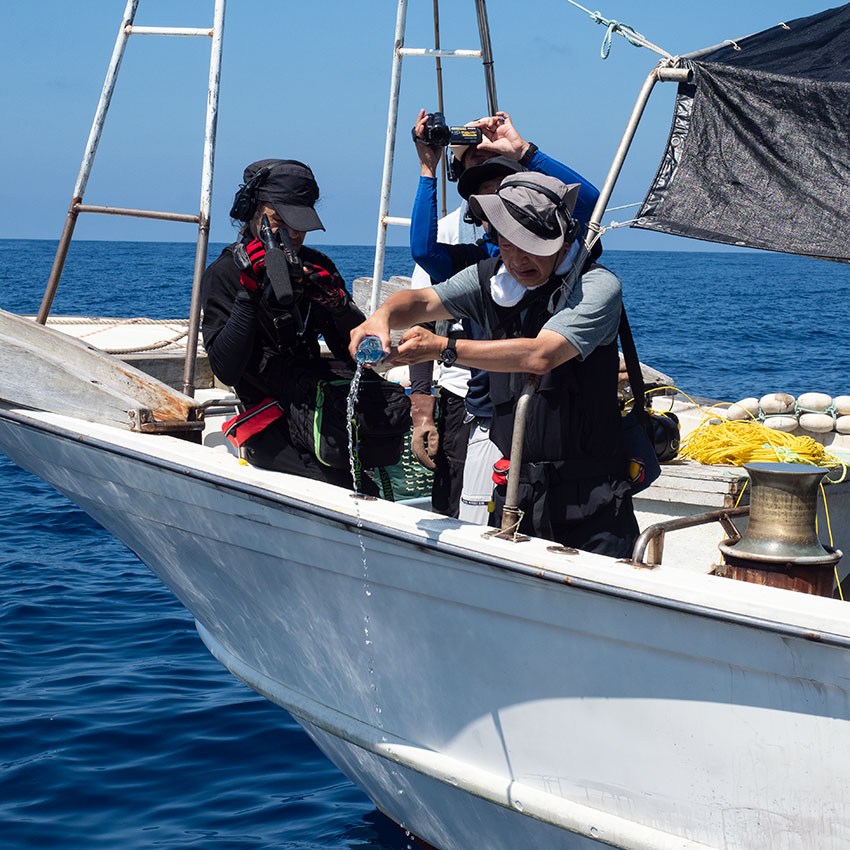
※ Mr. Nishinaka offers sake from the boat
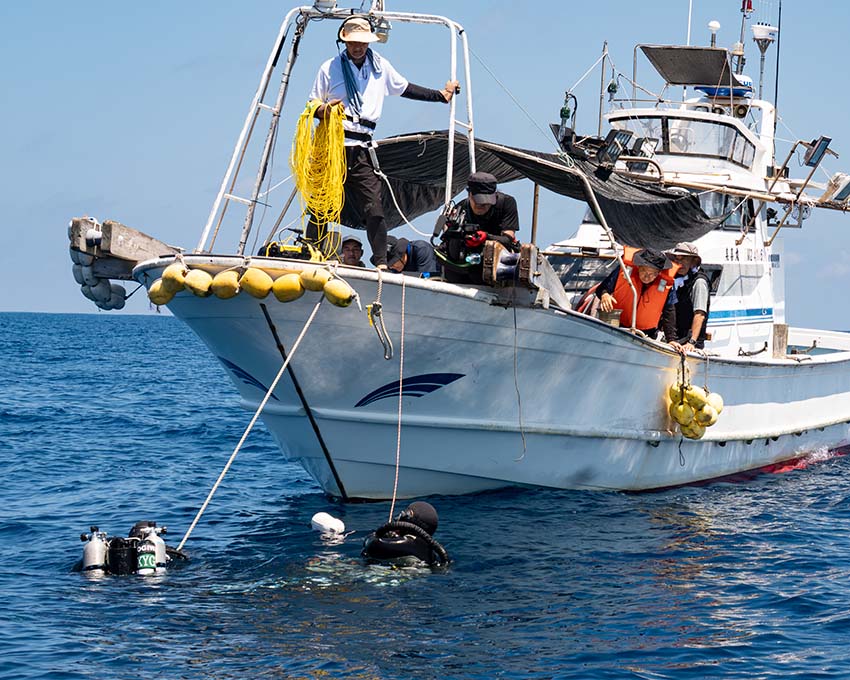
※ Beginning the descent on the Mikimaru's line
The Mikimaru dropped the anchor and the line went in. This procedure, too, was repeated about three times in order to place the anchor in a suitable position. For a dive in open ocean we want to aim for slack water, but unless the time these procedures take is also built into the schedule, the result can be that you reach the site and cannot dive.
Once the boat was secured, together with Mr. Nishinaka, a member of the bereaved family who was aboard the Mikimaru, we offered sake to the sea above the sinking site.
With the preparations finished, from here everything followed the procedure we had trained at Osezaki.
We set our cylinders on the line anchored by the Mikimaru. On deep dives it is often difficult to enter the water carrying all of your equipment on the boat. Multiple bail-out cylinders, a diver propulsion vehicle, filming equipment... To wait at the surface wearing all of that, in the motion of the boat, is itself a load, and a cause of trouble at entry.
We therefore set the equipment on the line in its designated positions in advance, entered with the minimum of gear, and donned it in the water. Who places which piece of equipment where, in what order it is put on, and how long that takes—this was the sequence we had confirmed at Osezaki.
Mr. Mori stayed at the surface and in the shallow depths and saw us into the water. Mr. Ogiwara and I took our diver propulsion vehicles and began descending along the line.
Shortly after we began the descent, the action camera mounted on the hot shoe of my camera came away.
On a dive in the 100-meter range, going after something you have dropped is not an option. If you leave the line you lose your own position, and there is no way back from there. Still less on this day, with a bottom time planned at 20 to 25 minutes. Any minutes spent searching would come straight out of the time we could spend beside Nagara. The decision not to go after it was made on the spot.
As a result, filming, which we had begun with three systems, continued with two. It could be said that the reason we had brought redundancy showed itself immediately.
Eight minutes of descent, drawn down into deep water. We reached 97.9 meters, the lower end of the line.
But Nagara was not there.
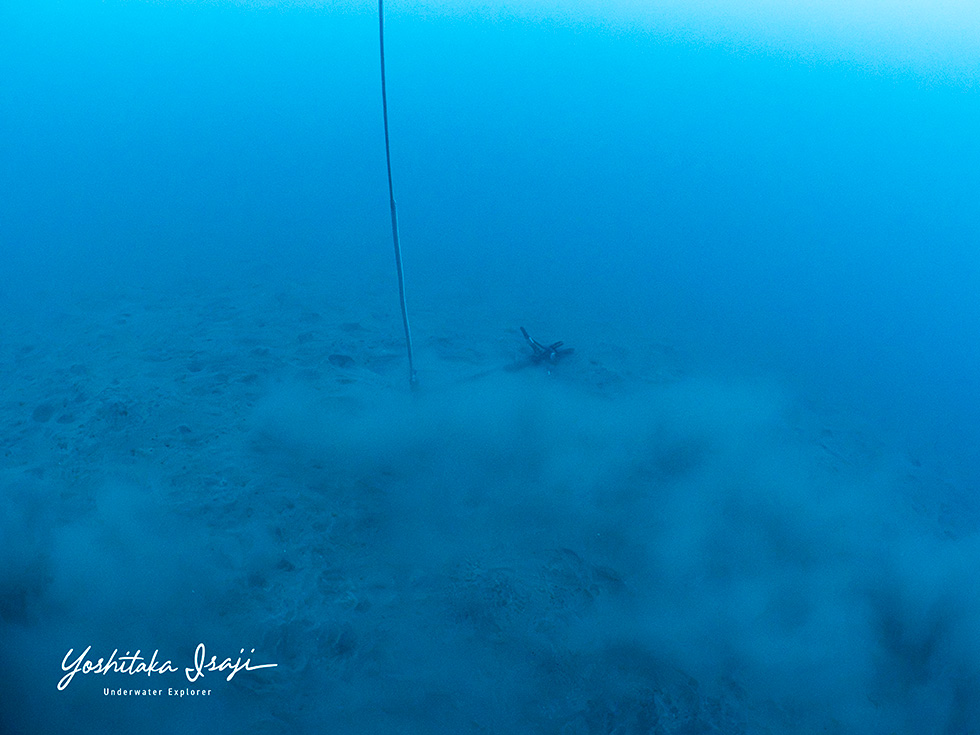
※ The lower end of the line, and the anchor. Nagara was not there.
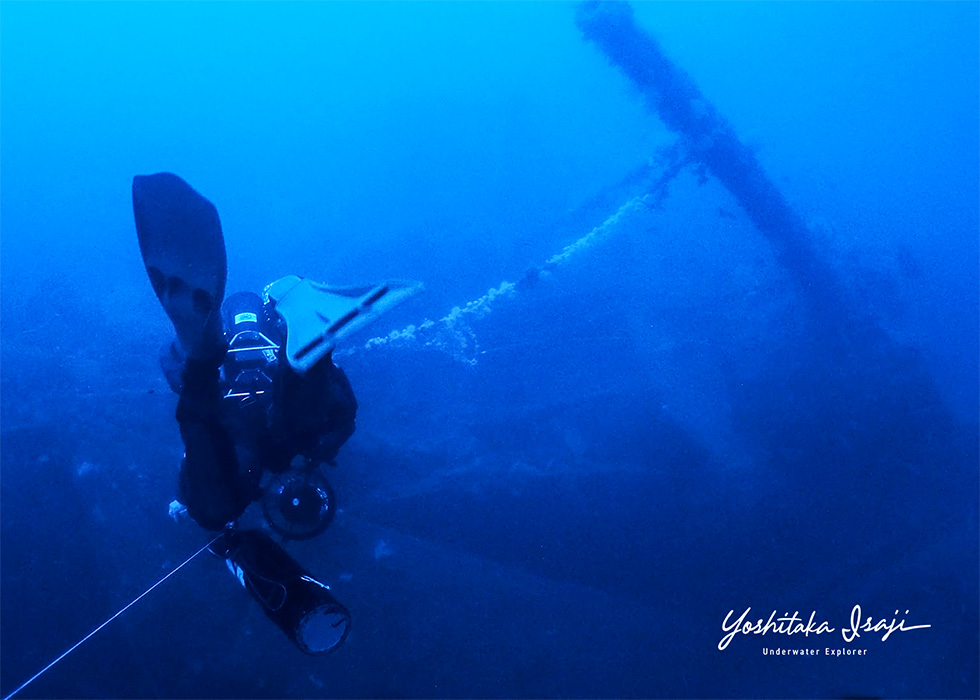
※ Nagara, found
Within the range we could see there was only a seafloor of open sand. Exactly the situation we had anticipated—and had agreed on with Mr. Ogiwara before entering the water—was now in front of us. From here it was a search. Mr. Ogiwara tied a line to the anchored line and set our direction toward the side the captain had told us the anchor was likely displaced to.
We had only our bottom time. Time spent searching would be subtracted directly from the time we could use beside Nagara. Even so, within a range we had decided on, we could move without hesitation—that is what deciding in advance means.
Thirteen minutes into the descent, a structure appeared at the edge of our vision.
On the deep seafloor, visibility, which had been about 15 meters near the surface, was an estimated 7 meters. In such conditions, what a structure is cannot be known until you are close. As the distance closed, the outline took shape.
It was a ship.
A ship that had been here for 82 years.
Mr. Ogiwara tied the line he had been running to the hull. With that, our way back was secured.
We were not able to confirm on this dive what condition the hull is in along its full length; but within the range we could see, the hull was not lying on its side—it stood on the seafloor in the same attitude it had held when afloat.
Moving to the left from the place where the line was tied, we came out at what appeared to be the bow of the hull. There were gun barrels and other structures particular to a warship, and I worked the camera with the thought that we could deliver this to the people who have been waiting for these photographs.
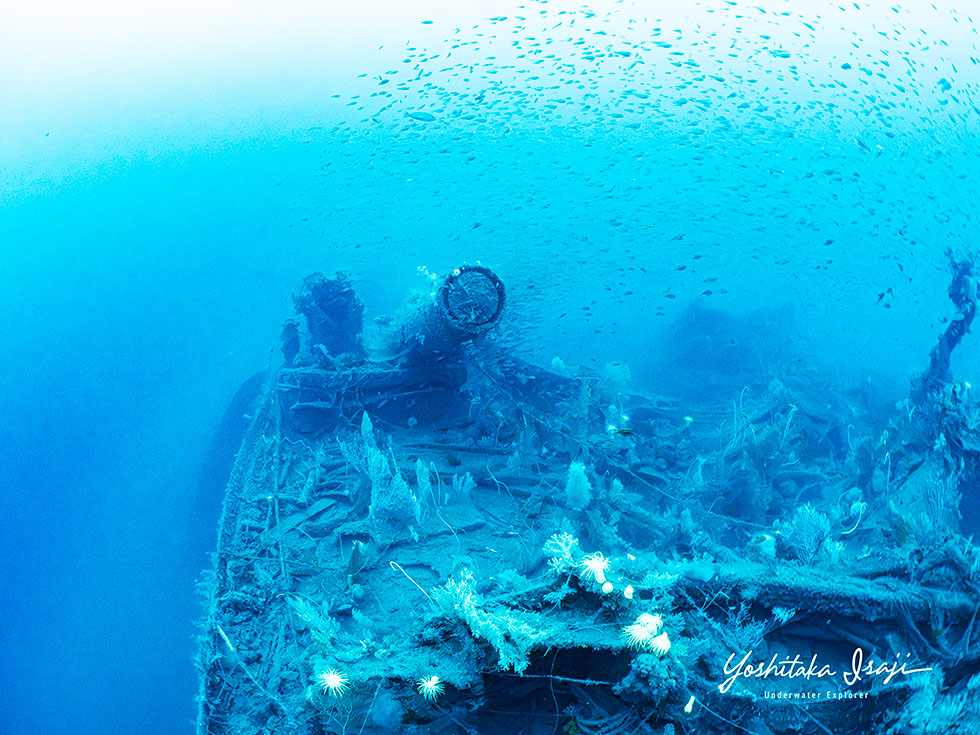
※ On the deck of Nagara. A gun barrel is visible.
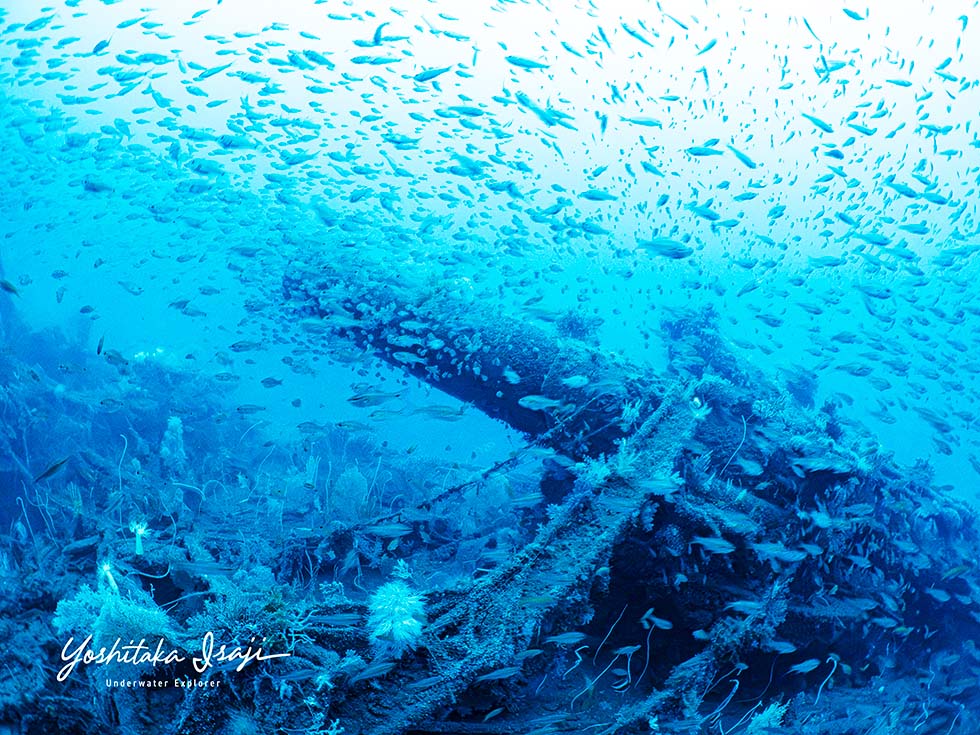
※ Now a fish reef, nurturing life
At the same time, we could not lose ourselves in the filming. A great deal of fishing line was tangled on the hull, and in places there were fishing nets as well. On a deep dive these are a serious risk. If you become entangled you cannot move, and if you spend time freeing yourself you cannot make the ascent you planned—so care is required.
Many fish had gathered around the hull. We observed that Nagara is now a fish reef. Locally it is called "Gunkan Sone" (literally, "warship reef"), and it appears to be a fishing spot as well.
In a place where many lives were lost, many lives are now being nurtured. Facing that sight, I felt something difficult to put into words.
We did not encounter any remains or personal effects.
Nineteen minutes after we began the descent, we decided to leave the hull and return to the line.
Under the plan we had adopted that day, we had a maximum of 25 minutes until the start of the ascent. But those 25 minutes were not time we could spend at the hull. They also had to cover the return from the hull to the line. Having reached Nagara by searching, the way back is the same distance.
And if we stayed to the limit and even one problem occurred on the way back, dealing with it would take time and we would pass the planned time for beginning the ascent. On a deep dive, exceeding it means directly increasing the decompression time, and with it the risk. The time for the return, and a margin for anything that might happen on that return—19 minutes was the point at which both could still be left.
We untied the line we had fixed and returned to the anchored line, reeling it in as we went, 23 minutes into the descent. We began the ascent along the line.
From there, the decompression to the surface took 139 minutes. Most of it was spent in the shallow layers. The water temperature that day was 27 to 28 degrees at the surface and 17 degrees at the bottom—conditions that improve decompression efficiency. Provided the heat during preparation on the boat is properly managed, summer is a welcome season for this kind of dive.
As we came up into the shallow depths, Mr. Mori was waiting. We told him that no problems had occurred, handed over the cylinders and equipment we no longer needed, and had them taken up to the surface. Here too we followed the procedure we had confirmed at Osezaki. We were able to spend the last part of the long decompression without carrying any unnecessary load.
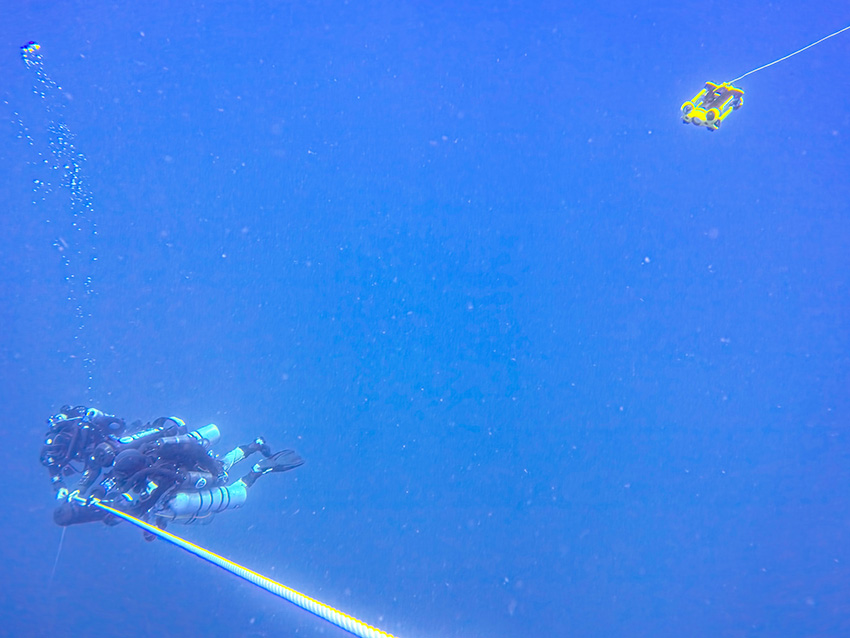
※ During decompression. The ROV, which accompanied us part of the way, is also visible.
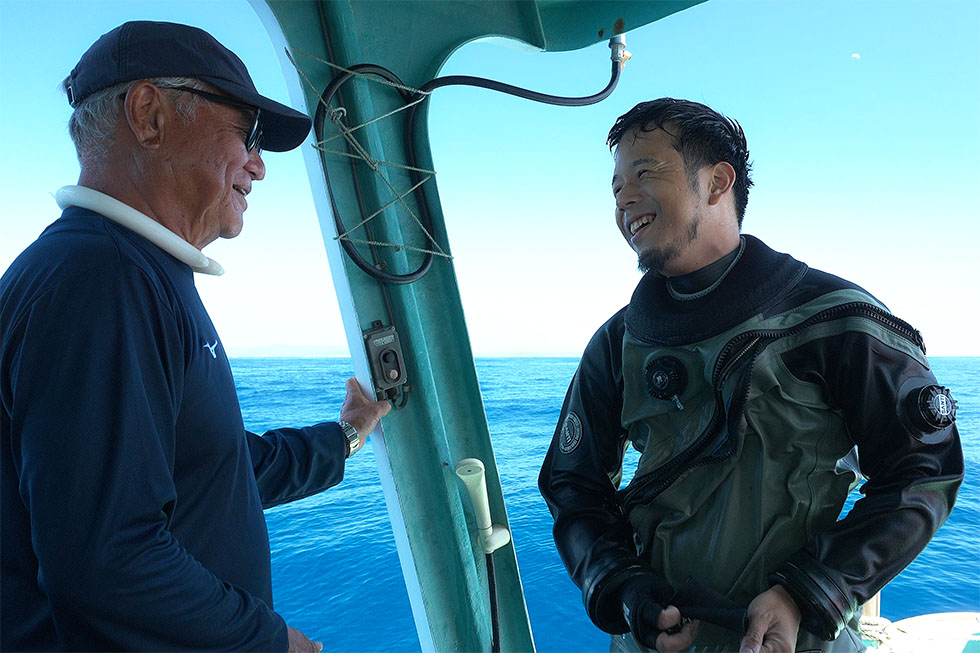
※ Reporting the result to Captain Hikaru Tomikawa
And then to the surface, and onto the boat. One hundred and sixty-two minutes had passed since we began the descent.
The total dive time was 162 minutes. Of that, the time we could spend beside Nagara was 6 minutes. The maximum depth recorded on the dive computer was 97.9 meters.
When we came aboard, everyone was waiting. When we told them that we had found Nagara and had been able to film it, relief and cheers spread across the boat.
For us, this dive was not something that ended with whether or not we could dive. On this day there were reporters aboard our boat; the ROV team and Mr. Nishinaka of the bereaved family were on the other boat; and those who have carried the memorial were waiting at the port. And beyond them are the bereaved families who have held this ship in their thoughts for 82 years.
To bring Nagara on the seafloor back as photographs. That was our task. Being able to report that we had them was, more than anything, the achievement of that day.
We had originally planned a second dive on July 22. The purpose of that day was different from the day before. Whereas July 21 was to take hold of a single point on the hull and reliably obtain photographs that show it is a ship, and photographs that could be handed to the bereaved families, July 22 was aimed at capturing the overall form of the hull on video.
However, the bottom was not at the 80 meters we had been told in advance, but at 100 meters. Having dived to 97.9 meters and carried out 139 minutes of decompression, we judged that diving to the same depth on consecutive days should be avoided, and at the point where the July 21 dive ended we decided not to dive the following day.
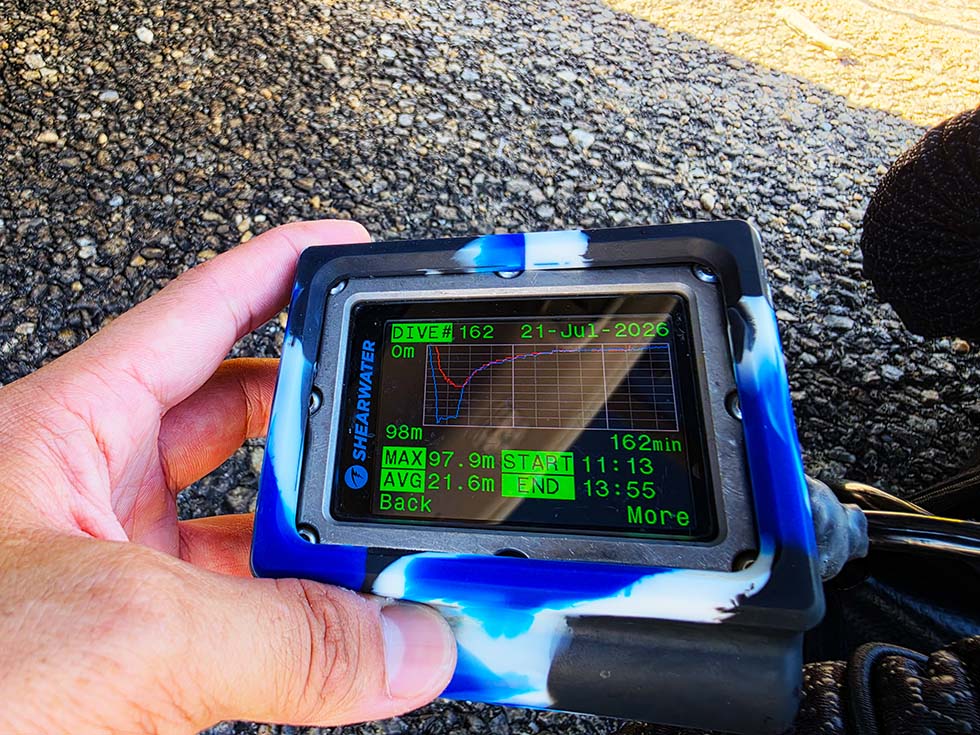
※ The dive log from this dive
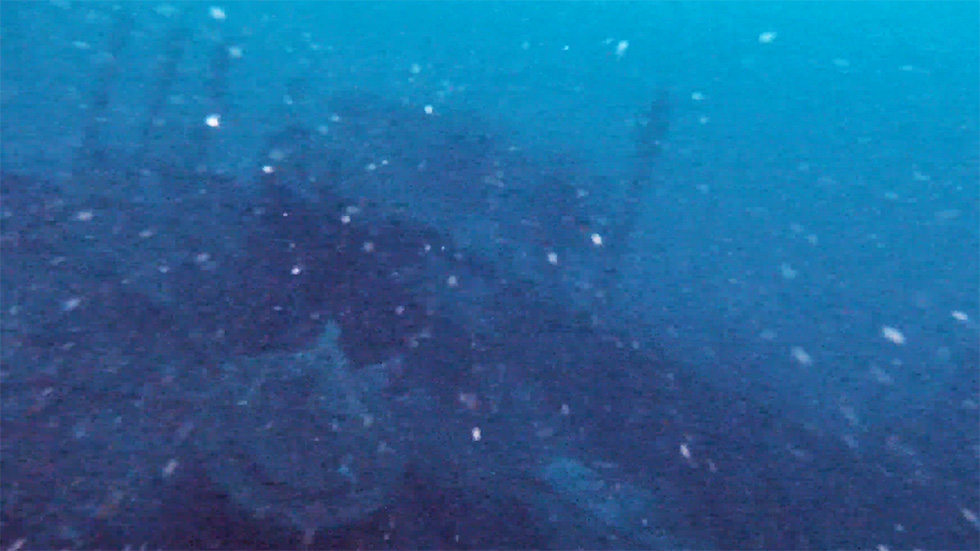
※ From the ROV footage (courtesy of Bellport Uto)
Instead of diving, Mr. Kazumichi Murai of Bellport Uto and Mr. Yoshiro Ishimatsu of Light Studio carried out filming with an ROV (remotely operated vehicle) for us. The ROV was deployed twice, and on both occasions recorded areas that appear to be on the bow side.
With the ROV we were able to capture a wider area than we had been able to see on the manned dive. It could be said that part of the purpose we had set for that day—capturing the overall form—was taken on by the unmanned vehicle.
With this, we were able to achieve two aims: clear photographs for the bereaved families and for the record, and an understanding of a wider area of Nagara.
That said, the condition of the hull along its full length is still not confirmed, and if those involved should wish for it, that would be a task for the future.
On the same day, we visited the grave of the late Tsuru Sasaki.
In an age when the sinking of Nagara went long unspoken after the war, she continued the memorial alone and used her own funds to build the memorial monument. At her grave we offered the photographs we had taken, and burned incense.
Those who came with us were Mr. Soichi Fukumoto, who was asked directly by Ms. Sasaki to take over the memorial work; Mr. Yasuharu Wakata, head of the Ushibuka Branch of the Amakusa City Social Welfare Council; Mr. Seiichiro Nishinaka; Mr. Kazumichi Murai of Bellport Uto and Mr. Yoshiro Ishimatsu of Light Studio, who carried out the ROV filming; and the members who took part in the dive.
Afterward we also went to the Hill of Remembrance. Before the monument, we reported that the investigation had been carried out, and we joined our hands in prayer.
To bring the form of Nagara resting on the seafloor to the place that has waited for it here for 82 years. To record, and to return that record to those who need it. This was the first step of what we should do on land in this investigation.
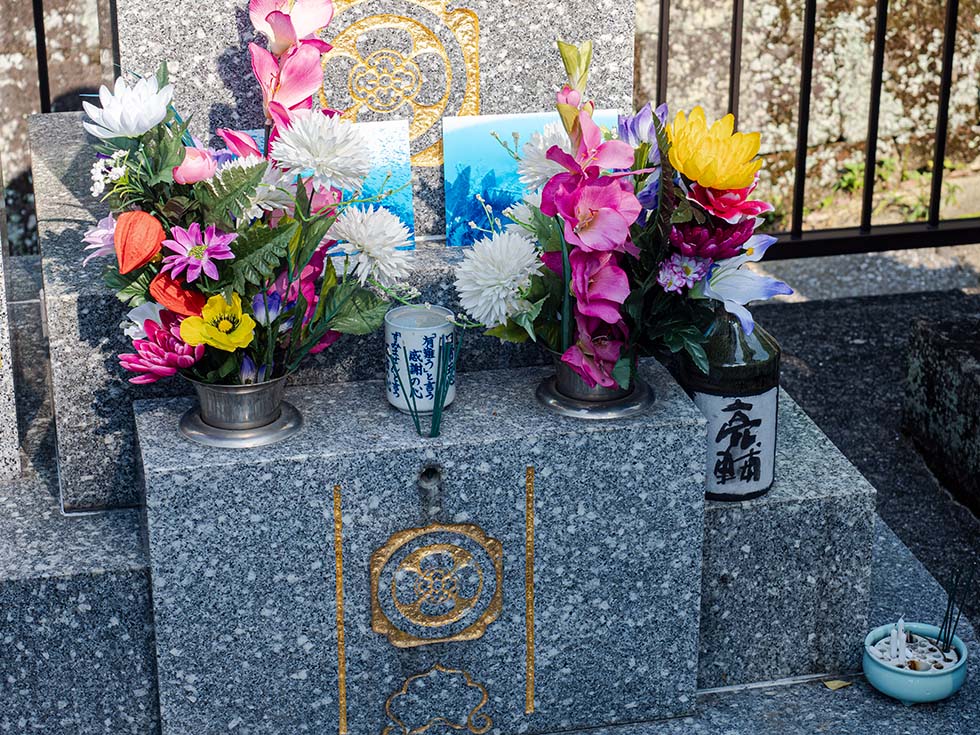
※ At the grave of Tsuru Sasaki
Related media coverage (About the Nagara Underwater Investigation)
With the dive on July 21 and the ROV filming on July 22, the diving for this project is complete. We will not use the reserve dates (September 3–4) that we had held in case the work could not be carried out during July.
From here, for the time being, this becomes a stage of delivering the records we brought back.
The media who came to cover the work have reported on it extensively since the day of the dive. Further coverage is planned, and we are grateful that this investigation is widening the opportunity for people to learn about Nagara, and above all about the people who have been involved with Nagara.
Our records have begun reaching the bereaved families. More than anything, knowing that people who had waited so long had received them made the work feel worthwhile.
In Ushibuka, we are scheduled to appear on the local station Mitsubachi Radio. First of all, we want to report directly to the people of the area who supported this work.
The crew of Nagara came from all over Japan, including the Hokuriku region. We hope to have opportunities to report in those regions as well, not only in Ushibuka.
Affiliations may not be up to date.



Copyright © 2024 Japan Karst & Underwater Exploration Project